Three days. That’s how long it had been since the Red Sea.
Think about what those people had just watched: the water standing up in walls, a nation walking through on dry ground, Pharaoh’s army going in after them and the sea coming down. Miriam had barely finished singing about it — and now the whole camp had walked three days into the desert of Shur and found no water. When they finally did find some, at a place called Marah, it was bitter. Undrinkable. Moses cried out to the Lord, and the Lord showed him a piece of wood. Moses threw it into the water, and the water turned sweet.
And it was there, at that pool — not at a sickbed, but at a place of bitterness made sweet — that God attached this name to Himself:
…If you will listen carefully to Yahweh your Elohim and do what he considers right, if you pay attention to his commands and obey all his laws, I will never make you suffer any of the diseases I made the Egyptians suffer, because I am Yahweh Ropheka.
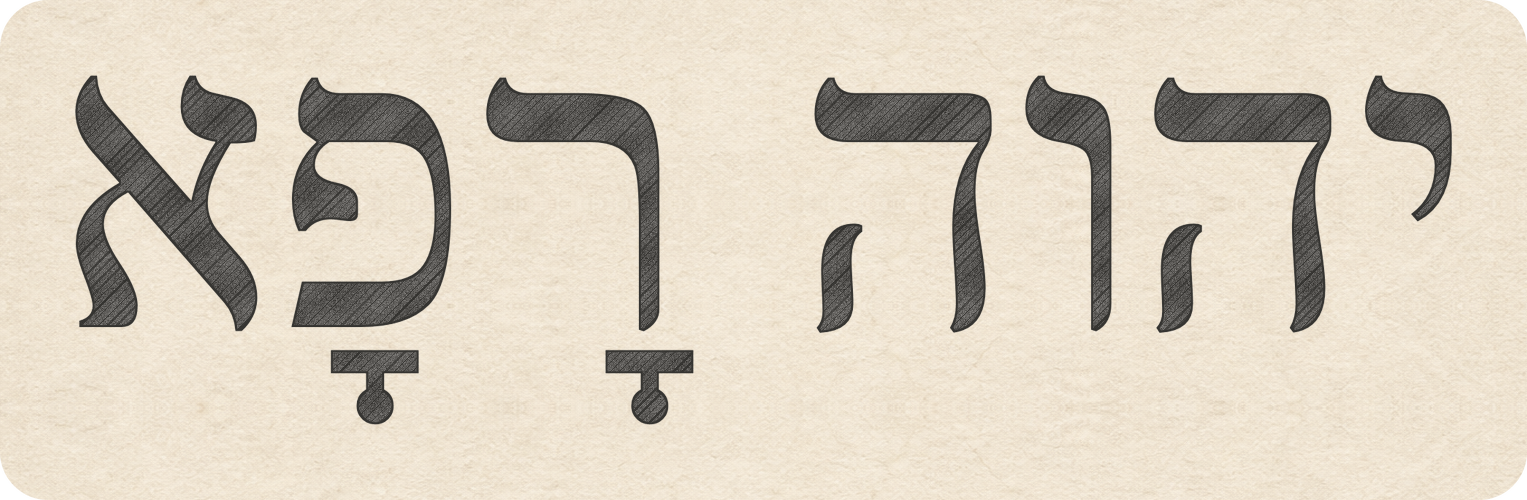
Yahweh Ropheka — the Lord your healer. You’ll see this name written a few different ways: Rapha, Rophe, Ropheka. They’re all the same word. The Hebrew root is rapha — “to heal, to restore, to make whole” — and rophe is its participle, “the one who heals.” Add the little ending in the verse above and you get “your healer.” Not a healer. Not the healer, generically. Yours.
And here’s what I love about the way Scripture uses that word: it is never limited to bodies. God rapha-heals bitter water (this very story, and a poisoned spring in 2 Kings 2). He heals land (2 Chronicles 7:14). He heals broken hearts (Psalm 147:3). He heals backsliding — the wandering of a soul (Jeremiah 3:22, Hosea 14:4). Jehovah Rapha heals the entire person: body, mind, and soul — and sometimes the water and the land while He’s at it.
He was doing it all through the Old Testament. Miriam, struck with leprosy, healed at Moses’ prayer. Naaman the Syrian general, dipped seven times in the Jordan, his skin restored like a young boy’s. King Hezekiah, told to set his house in order, healed and handed fifteen more years. And when Israel was dying of snakebite in the wilderness, God had Moses lift up a bronze snake on a pole — everyone who looked at it lived. Remember that one; it comes back.
When the Old Testament was translated into Greek, rapha became iaomai — to heal, to cure. And by the time Jesus walks onto the scene, the Greek words for healing and the Greek word for salvation (sozo) are wrapped around each other: sozo means to save, to heal, to deliver — from death, from demons, from sickness, and from sin. The Healer Himself had arrived, and He spent His days proving the name: the blind man who saw. The lame man lying beside the pool of Bethesda, thirty-eight years into his condition. The ten lepers cleansed on the road. The bleeding woman who touched the hem of His garment after twelve years of doctors. The man at Lystra, lame from birth, on his feet in front of Paul and Barnabas. Every one of them met Jehovah Rapha in person.
And then He did the biggest healing of all. Isaiah had promised it centuries earlier:
But he was pierced for our transgressions, he was crushed for our iniquities; the punishment that brought us peace was on him, and by his wounds we are healed.
Ann Spangler draws the two trees together this way: “The tree on which Jesus was impaled is like the tree God instructed Moses to throw into the bitter waters of Marah. This time God plunged his Son into the waters of death. But instead of being swallowed up by them, he rose up alive again, becoming living water for all who seek him.” The cross is Marah, finished: the bitterest water there is — death itself — made sweet, and our deepest disease, sin, healed at the root. He died, He rose, and everyone who looks to Him lives — just like the wilderness and the bronze snake, which is exactly the picture Jesus reached for when He explained it (John 3:14–15).
So let me say the quiet part out loud: God still heals. Today — bodies, minds, souls, and everything in between. This name is intensely personal to me. You’ll find the stories behind it in The Goodness of God.
If something in you is bitter water right now — a body that hurts, a mind that won’t rest, a soul that’s wandered — bring it to Marah. Ask Him. He put His name on this one.
Heal me, LORD, and I will be healed; save me and I will be saved, for you are the one I praise.